
The Institute of Post Conflict Development
The Story
Akar: From Resistance to Renewal
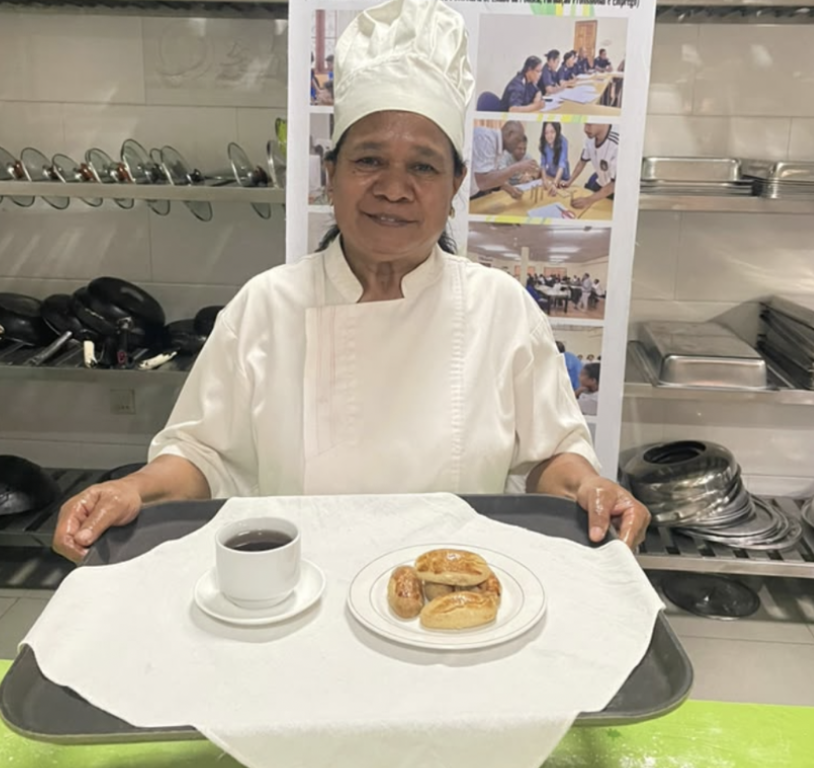
Maria Tilman is a 56-year-old mother of two and proud grandmother of a baby girl. Hailing from Cotalala, Same, in the Municipality of Manufahi, Timor-Leste, Maria’s childhood was challenging, she never attended school and was raised by her uncle.
Following the 1999 referendum, she relocated to Dili, where an aunt returning from Australia provided support. There, Maria seized the chance to learn basic literacy and cooking. Her culinary talent caught ETDA’s attention, leading her to their commercial kitchen. Working alongside various chefs, she refined her craft and invented her famous “Akar” biscuits. Embracing ETDA’s “learn by doing” philosophy, Maria now confidently mentors hospitality interns, sharing her hard-won skills.
My name is Maria. I am a single mother and a chef at ETDA’s Hospitality Training Centre in Timor-Leste. My signature recipe is “Akar”, a biscuit made from sago flour.Hounded. Hunted. Haunted.
For years, Timorese resistance fighters hunkered down in the mountain jungles, fighting the Indonesian military which had illegally invaded our homeland. Starvation was as fierce an enemy as the soldiers across the border. With military blockades destroying village crops, desperate civilians and FALINTIL fighters relied on ancestral knowledge to forage for traditional bush foods.
Sago flour was a lifeline. When the Indonesian army burned our villages, families fled to the mountains and survived on sago palm trees. The spongy center was mixed with water to filter the starch, dried, pounded into powder, and mixed with water again to form an edible paste. This “hero food” filled empty stomachs and didn’t need cooking—avoiding tell-tale smoke that could betray positions. It sustained the resistance through the darkest years.
I have vivid childhood memories from Same during Indonesian times of my father cutting down sago palms. Sometimes we mixed sago with red beans and baked it—that was all we had to eat. I knew many people who died of starvation in the jungle.
Today, 50 years after the invasion and 24 years since independence, “akar” is used in a new way. Timor-Leste is now free and peaceful. I serve Akar biscuits with Timorese coffee—not as survival food, but as a symbol of hope, resilience, and peace.
I am happy to share my recipe with the younger generation. Every day at ETDA, I teach young Timorese students how to prepare this traditional food—not just as a culinary skill, but to connect with our history and culture. When I see my students’ hands mixing sago flour, rolling dough, and placing biscuits in the oven, I see Timor-Leste’s future taking shape. They learn more than a recipe; they learn resilience, pride, and the importance of remembering our roots.
For me, making Akar biscuits is a meeting of past trauma with hope and renewal. Each biscuit carries the weight of our struggle and the sweetness of our freedom. What once sustained a resistance now brings people together around the table—a quiet testament to resilience, peace, and hope. Through my students, this tradition will live for generations.
Food is memory. It carries the weight of struggle and the sweetness of freedom. When we share a meal, we share our identity, our dignity, and our hope for a better future. The table is where we remember where we came from and dream of where we are going—together. From survival to celebration. From resistance to renewal. This is the story of akar—and the story of Timor-Leste.
Maria Tilman, 56
Dili, Timor-Leste
Recipe
Maria’s Akar Shortbread Biscuits
Ingredients:
1 liter oil
1 egg
1 kg sago flour (made from dried and ground sago palm center)
½ cup sugar (or palm sugar for a traditional touch)
Method:
1. Prepare the sago flour: If using fresh sago, grate or pound the dried sago center into a fine powder. Sift to remove any coarse pieces.
2. Mix the sugar and oil together until well combined and slightly fluffy.
3. Add the sago flour and mix well until a soft dough forms.
4. Shape the dough into small round balls by hand.
5. Brush the tops of the round balls with beaten egg before baking.
7. Preheat the oven to 200°C.
8. Bake for 15-20 minutes or until the edges are lightly golden.
9. Cool on a wire rack before serving.
Serving suggestion: Enjoy with a cup of freshly brewed Timorese coffee, a taste of peace and resilience in every bite.
“The views presented here do not necessarily represent the views of the Foundation for Post Conflict Development. They serve as a people to people exchange of information based on values of respect and desire for cultural and diplomatic understanding without judgement. All points of view are welcome and are necessary to better understand the context of post conflict development. It is in this spirit that the FPCD created this Institute.”