
The Institute of Post Conflict Development
The Story
Little Hands
Deema Tamimi is a California based community organizer, food advocate, and Palestinian-Egyptian American, with a background in marketing and product management at Xbox, YouTube, and Figma before shifting her focus more fully to social justice work.
She founded Land & Ladle, a nonprofit centered on sustainable food systems, and serves on the Davis Human Relations Commission, supporting immigrant justice and marginalized communities. She organizes for Palestinian and collective liberation, including volunteering with the Global Sumud Flotilla, and believes food, art, and gathering are powerful tools for connection and truth telling. She lives with her husband, two kids, and occasionally a foster cat.
In 2013, my father nearly died, and from his hospital room I promised myself that if he survived, I would finally go to Hebron, Palestine to visit the grandmother and family I had letbecome strangers. He survived, and I kept that promise a year later, sitting with my 93 year old grandmother in a city that had been occupied by several ruling powers without her leaving it. That trip is why I cook the way I do now, and why I stopped letting myself be just American, disconnected from a heritage waiting for me.
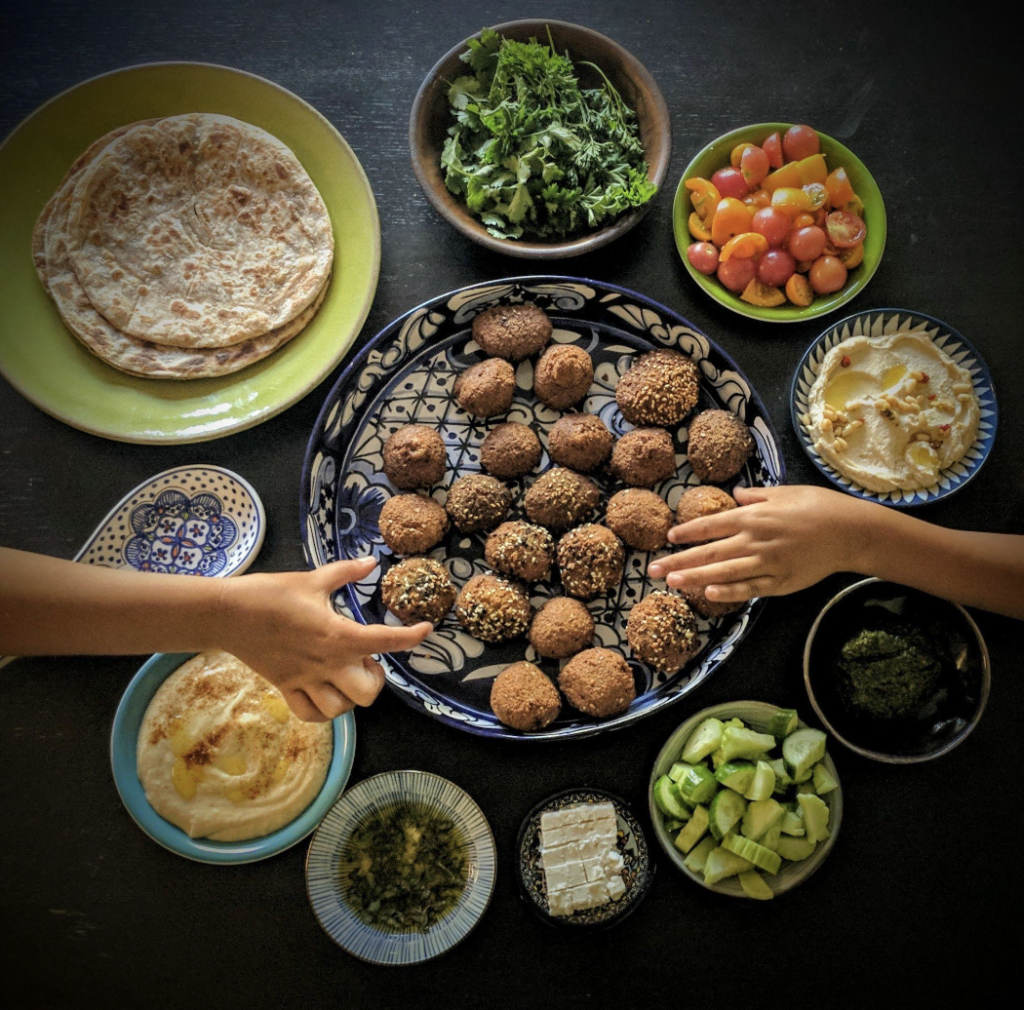
This falafel photo was taken not long after, one of the first times I recreated that food at home. I wanted my kids to grow up reaching for this food as inheritance, not just cuisine. That day their hands reached for the platter at once, and I caught it without any staging or prompting.
I posted it originally as a simple food culture share, no different from my other food posts. Years later, as Israel’s assault on Gaza ground on, month after month, and I kept seeing photographs of small hands pulled from under concrete, I reposted the same photo with a line that rang true in my mind: little hands should be reaching excitedly for falafel, not lifelessly from rubble. I wrote that because I needed people scrolling past another headline to sit with the fact that Palestinian children are supposed to have a table, hands full of something warm, and instead tens of thousands have had their lifeless hands pulled from rubble. I gave a photo that once needed no context a context, on purpose, because joy without this heavy context was no longer the whole truth.
That same refusal to let our food culture disappear is why, years later, I was thrilled to help cook and organize a meal in Davis built around produce grown from seeds out of the Palestinian Heirloom Seed Library, work led by Vivian Sansour, who has spent years saving seed varieties Palestinian farmers have grown for generations, because losing seeds under occupation is another way a culture gets erased. Watching people eat, converse and learn over food grown from those seeds was one of the most moving exercises in storytelling I’ve been part of, part of the same thread as this photo.
This is what culinary diplomacy means to me. My family’s food has survived exile, occupation and checkpoints to land on a table in California. That survival is not separate from what is happening in Gaza right now, it is part of the same story, a story of resistance against erasure. The table is not a place to look away from that. It is one of the few places left where I can put both truths in front of someone at once and ask them not to leave until they reckon with what a genocide costs a people who, like all people, only want their children’s hands full of food, not rubble.
“The views presented here do not necessarily represent the views of the Foundation for Post Conflict Development. They serve as a people to people exchange of information based on values of respect and desire for cultural and diplomatic understanding without judgement. All points of view are welcome and are necessary to better understand the context of post conflict development. It is in this spirit that the FPCD created this Institute.”